18 September 2026 · 6 min read
Polyphenols in Olive Oil: What the Number on the Label Really Measures
Polyphenols are the antioxidant compounds that make olive oil bitter and peppery, and they range from roughly 50 to 1,000 mg/kg. The famous 250 mg/kg figure is not a quality grade: it is the EU condition for one narrow health claim, and it counts only hydroxytyrosol and its derivatives, not total phenols.
This article provides general information and is not medical advice. Discuss health decisions with a qualified professional.
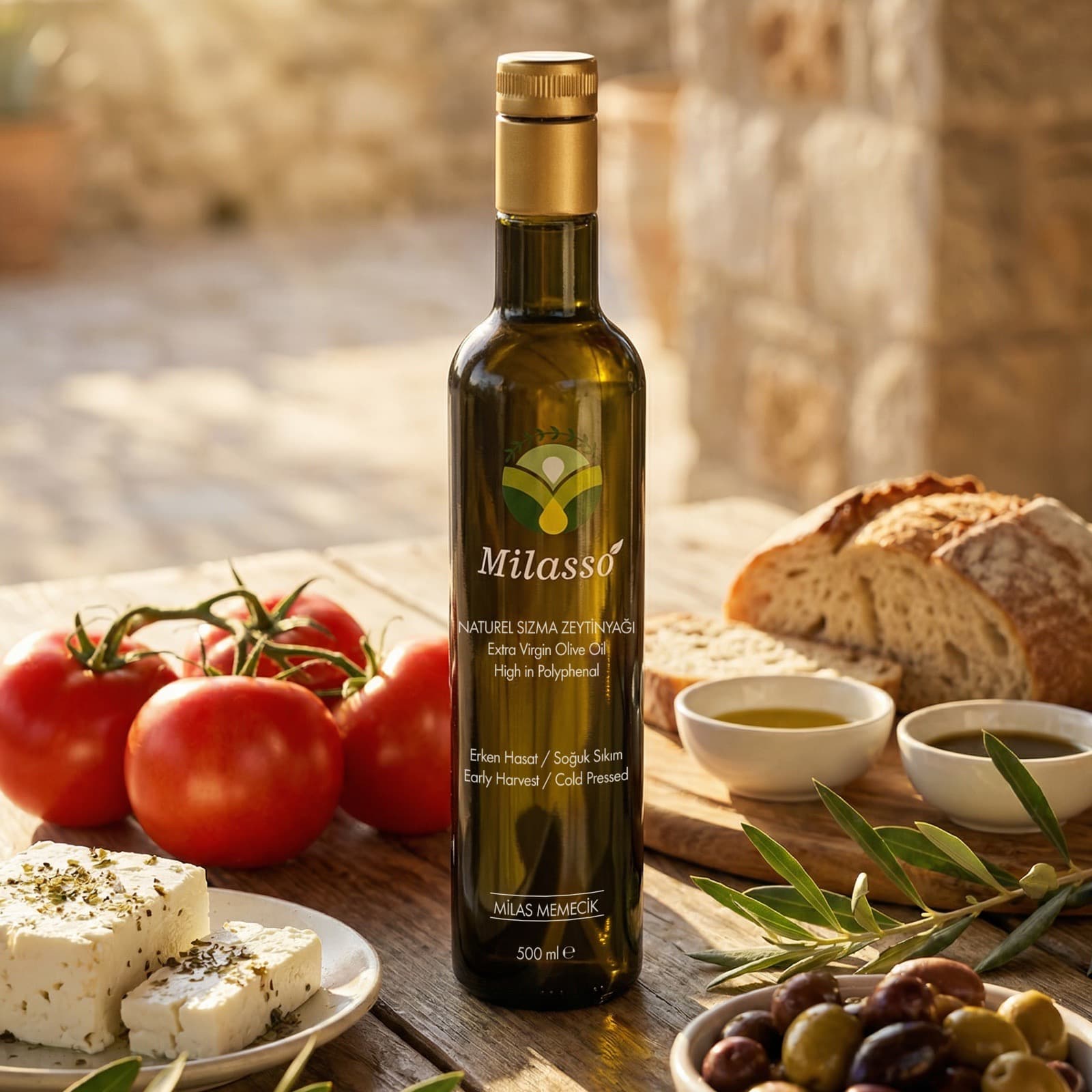
Polyphenols are the antioxidant compounds olive oil carries over from the olive fruit, and they are what make a fresh oil taste bitter at the back of the tongue and peppery in the throat. Across the world's virgin olive oils the total content runs from roughly 50 to 1,000 mg/kg, depending on variety, ripeness at harvest, extraction and storage. The figure quoted everywhere as the benchmark — 250 mg/kg — is not a grade and not a quality ranking. It is the condition attached to one narrow health claim in EU law, and it counts a specific subset of compounds rather than everything a total-phenol test picks up.
What "polyphenols" actually covers
Olive oil contains more than thirty phenolic compounds, and they are not interchangeable. The ones that matter for both taste and regulation are:
- Hydroxytyrosol and tyrosol — the simple phenolic alcohols, quantitatively dominant once the complex forms break down.
- Secoiridoids — oleuropein and ligstroside derivatives, including oleocanthal (the peppery sting) and oleacein. In a fresh oil most hydroxytyrosol is bound inside these larger molecules rather than sitting free.
- Lignans, flavonoids and phenolic acids — genuine polyphenols, present in smaller amounts, which a total-phenol test counts but the EU claim does not.
That last line is where most published guidance goes wrong.
The 250 mg/kg number, precisely
Commission Regulation (EU) No 432/2012 authorises one claim for olive oil polyphenols: that they contribute to the protection of blood lipids from oxidative stress. The condition of use is that the oil contains at least 5 mg of hydroxytyrosol and its derivatives (e.g. oleuropein complex and tyrosol) per 20 g of olive oil, and the consumer must be told the effect is obtained with a daily intake of 20 g.
5 mg per 20 g is arithmetically 250 mg/kg, which is where the familiar figure comes from. But read what is being counted: hydroxytyrosol and its derivatives, not total phenolics. A producer's "total polyphenols: 300 mg/kg" — usually measured by the Folin-Ciocalteu colorimetric assay and reported in caffeic or gallic acid equivalents — is a different quantity measured a different way. The authors of the 2019 UHPLC protocol published in *Molecules* state it flatly: the Folin-Ciocalteu assay cannot support the health claim. The regulation named no official method, which is why laboratories had to develop hydrolysis-based protocols that convert the bound forms into measurable free hydroxytyrosol and tyrosol before quantifying them.
So "above 250" on a total-phenol report is not the same statement as "meets the 432/2012 condition", even though the two are routinely printed as though they were.
How many oils actually clear the bar
Two datasets give a sense of scale.
- Bellumori and colleagues (*Molecules*, 2019) measured 108 Italian virgin olive oils after sulfuric acid hydrolysis: about 75% met the 5 mg per 20 g threshold. Roughly one in four did not.
- A qNMR survey of 5,764 Greek samples collected between 2009 and 2020 found 74% above 250 mg/kg.
Both sets come from oils submitted for analysis, which skews the result upward — producers who test tend to be producers with something to show. The honest reading is that a well-made extra virgin oil often clears the threshold, that a meaningful minority does not, and that nothing on a standard label tells you which one you are holding.
The number is a snapshot, and it has a half-life
Phenolics degrade. The Greek dataset found samples retained 54.1% of their original total phenolic content after twelve months at room temperature — a loss of roughly 46% in a year. That is why the same authors proposed that "high-phenolic" should mean above 500 mg/kg at bottling: only then is the oil likely to still clear 250 mg/kg a year later. They reserved "exceptionally high phenolic" for oils above 1,200 mg/kg, the top 5% of their samples.
This reframes the shopping question. A measurement without a harvest date, a lot number and a measurement date tells you very little, because you are not buying the number — you are buying whatever is left of it when you open the bottle. An oil analysed at 600 mg/kg eighteen months ago may well sit below a fresher oil analysed at 350.
What the health evidence supports, and what it does not
The EU claim is deliberately narrow: protection of blood lipids from oxidative stress, at 20 g of oil a day. Beyond it, a 2023 meta-analysis in *Metabolites* pooled 10 randomised controlled trials with 991 participants and reported that olive oil polyphenol intake was associated with a significant increase in HDL cholesterol, with a slight reduction in LDL at higher intakes. The authors flag the limits themselves: mostly short interventions, small samples, heterogeneous populations, and no differentiation between cultivars or oil types.
None of that makes a high-polyphenol oil a treatment for anything, and results of this kind do not convert into a dose you should take. If you are managing cholesterol, blood pressure or any diagnosed condition, discuss dietary changes with your doctor rather than with a label.
Can you taste them?
Partly. Bitterness and the peppery catch at the back of the throat — the oleocanthal response — do track phenolic content, and an oil that tastes of nothing almost certainly has little left. But intensity varies by compound and by cultivar, and no palate distinguishes 300 mg/kg from 600. Taste tells you an oil is alive; only a lot analysis tells you by how much. The sting itself is worth understanding on its own terms: see why olive oil burns your throat.
What this looks like in one harvest
Two figures from our own lot register show the mechanism better than any general guide can. Both lots are Memecik olives from Milas, both pressed the same day they were picked in a closed system, both from the 2025-26 season:
- Lot 2025-EH-03 (October pick, early harvest): total polyphenols 384 mg/kg, acidity 0.28%, peroxide 7.4.
- Lot 2025-EH-05 (November pick): total polyphenols 287 mg/kg, acidity 0.42%, peroxide 8.9.
Same region, same variety, same press, same day-of-harvest processing. The one real variable is about a month of further ripening on the tree — and it costs roughly a quarter of the phenolic content, while the acidity rises with it. That is the entire economic argument for early harvest: green olives give less oil per kilo of fruit, which is why the Ultra Premium 500 ml from the October lot is priced as it is, and why the Premium 5 L tin from the later pick is the one built for everyday cooking.
We publish these as measured total-polyphenol values per lot, with the harvest month attached. We do not present them as proof of compliance with the 432/2012 condition, because a total-phenol figure is not the measurement that regulation asks for — and we would rather say so than round the difference in our own favour. For the grade definitions underneath all of this, start with what extra virgin actually means and what early harvest olive oil is, then look at the olive oil range and the Memecik variety it comes from.
Frequently Asked Questions
- How many polyphenols should olive oil have?
- There is no minimum in the extra virgin grade itself. The reference point most people use is the EU health claim condition of 5 mg of hydroxytyrosol and derivatives per 20 g, equivalent to 250 mg/kg. Researchers analysing thousands of samples have proposed 500 mg/kg at bottling as a working definition of high-phenolic, because phenolics fall by roughly half over a year.
- What does 250 mg/kg mean on an olive oil label?
- It is the arithmetic form of the EU condition of use for one authorised claim: at least 5 mg of hydroxytyrosol and its derivatives per 20 g of oil, with the consumer told the effect relates to 20 g daily. It is not a quality grade, and it refers to that specific group of compounds rather than to a total-phenol reading.
- Is a total polyphenol figure the same as meeting the EU health claim?
- No. Total phenolic content is usually measured by the Folin-Ciocalteu assay in caffeic or gallic acid equivalents, which counts lignans, flavonoids and phenolic acids as well. The 2019 UHPLC protocol paper in Molecules concluded that this assay cannot support the claim; compliance requires hydrolysis-based measurement of hydroxytyrosol and tyrosol specifically.
- Do polyphenols in olive oil decrease over time?
- Yes, steadily. In a survey of 5,764 Greek samples, oils retained about 54% of their original total phenolic content after twelve months at room temperature. Heat, light and oxygen accelerate the loss. This is why a polyphenol figure is only meaningful alongside a harvest date, a lot number and the date the sample was analysed.
- Which olive oil has the highest polyphenols?
- Generally an early-harvest oil from a phenol-rich cultivar, pressed quickly at low temperature and stored away from light and heat. Ripeness at picking matters most: in our own 2025-26 lots, an October pick measured 384 mg/kg while a November pick of the same variety measured 287 mg/kg. Cultivar and crop year shift the range too.
- Can you taste polyphenols in olive oil?
- You can detect their presence but not their quantity. Bitterness on the tongue and a peppery catch in the throat, caused largely by oleocanthal, indicate that phenolics are still there, and an oil that tastes flat has usually lost them. Sensitivity differs between compounds and palates, so tasting cannot replace a lot analysis.
Sources
- In House Validated UHPLC Protocol for the Determination of the Total Hydroxytyrosol and Tyrosol Content in Virgin Olive Oil Fit for the Purpose of the Health Claim Introduced by the EC Regulation 432/2012, Molecules (2019)
- Bellumori et al., The EFSA Health Claim on Olive Oil Polyphenols: Acid Hydrolysis Validation and Total Hydroxytyrosol and Tyrosol Determination in Italian Virgin Olive Oils, Molecules 24(11):2179 (2019)
- A New Definition of the Term “High-Phenolic Olive Oil” Based on Large Scale Statistical Data of Greek Olive Oils Analyzed by qNMR (2021)
- Olive Oil Polyphenols Improve HDL Cholesterol and Promote Maintenance of Lipid Metabolism: A Systematic Review and Meta-Analysis of Randomized Controlled Trials, Metabolites 13(12):1187 (2023)